

AML Compliance for Iraqi Banks

AML Compliance for Iraqi Banks Anti-money laundering (AML) compliance is one of the most critical and commercially consequential areas of Iraqi banking regulation. Iraq’s placement on the Financial Action Task Force (FATF) enhanced monitoring list commonly known as the grey list has focused international attention on the adequacy of Iraq’s AML framework and the compliance practices of its banks. For Iraqi banks, AML compliance is not merely a regulatory obligation: it is the foundation of their ability to maintain correspondent banking relationships, access USD clearing, and participate in the international financial system. This article provides a comprehensive guide to AML compliance requirements for Iraqi banks under both Iraqi law and international FATF standards. The Iraqi AML Legal Framework The primary legislation governing AML compliance in Iraq is AML Law No. 39 of 2015 (the AML/CFT Law), which establishes the comprehensive legal framework for combating money laundering and terrorism financing. The law: defines money laundering and terrorism financing offences; establishes the obligations of financial institutions and designated non-financial businesses; creates the Anti-Money Laundering and Countering Financing of Terrorism (AMLCFT) Office as the national supervisory authority; imposes customer due diligence, record-keeping, and suspicious transaction reporting obligations; and provides for international cooperation in AML matters. The CBI has issued implementing instructions under AML Law No. 39 providing detailed guidance on how Iraqi banks must implement their AML obligations. FATF and Iraq’s Grey List Status The Financial Action Task Force (FATF) is the international standard-setter for AML and CFT. FATF’s 40 Recommendations set out the measures that countries should implement to protect the international financial system from money laundering and terrorism financing. Iraq was placed on the FATF enhanced monitoring list (grey list) following a mutual evaluation that identified deficiencies in its AML/CFT framework. Grey list status has severe practical consequences: international banks apply heightened due diligence to transactions involving Iraqi parties; correspondent banking relationships become more expensive and difficult to maintain; and USD clearing access is constrained. Iraq has committed to addressing identified deficiencies and is working toward removal from the grey list a process that requires demonstrable improvements in AML implementation. Customer Due Diligence — CBI Requirements CBI AML instructions require Iraqi banks to implement comprehensive customer due diligence (CDD) programmes addressing: customer identification and verification obtaining and verifying the identity of all customers using reliable, independent documentary evidence; beneficial ownership identification identifying and verifying the identity of the beneficial owners of legal entities who ultimately own or control the customer; understanding the nature of the customer’s business and the purpose of the banking relationship; enhanced due diligence (EDD) for high-risk customers including politically exposed persons (PEPs), customers from high-risk jurisdictions, and customers with complex ownership structures; and ongoing monitoring continuously monitoring the customer relationship and transactions for consistency with the risk profile. Suspicious Transaction Reporting AML Law No. 39 of 2015 requires Iraqi banks to file suspicious transaction reports (STRs) with the AMLCFT Office where the bank has reasonable grounds to suspect that a transaction involves money laundering or terrorism financing. CBI instructions provide guidance on the STR filing process, including: the timeframe for filing, STRs must be filed promptly upon suspicion arising; the information required, the report must include full details of the transaction, the customer, and the basis for suspicion; the tipping-off prohibition, banks must not disclose to the customer that an STR has been filed; and the safe harbour, banks filing STRs in good faith are protected from liability for breach of confidentiality obligations. FATF 40 Recommendations — What Iraqi Banks Must Implement The FATF 40 Recommendations set out a comprehensive framework that Iraqi banks are expected to implement, including: Recommendation 10 customer due diligence requirements; Recommendation 11, record-keeping; Recommendation 12 politically exposed persons; Recommendation 13 correspondent banking; Recommendation 15 new technologies and virtual assets; Recommendation 16 wire transfers; Recommendation 20 suspicious transaction reporting; and Recommendation 21 tipping-off and confidentiality. Iraqi banks should conduct gap analyses against the FATF Recommendations to identify areas requiring enhanced compliance measures. Correspondent Banking AML Requirements Maintaining correspondent banking relationships is the most commercially critical AML compliance challenge for Iraqi banks. International correspondent banks particularly US and European institutions providing USD clearing require Iraqi respondent banks to demonstrate robust AML programmes meeting international standards. Key requirements that international correspondents assess include: the adequacy of the Iraqi bank’s CDD and EDD procedures; the quality of its transaction monitoring systems; its STR filing record and relationship with the AMLCFT Office; compliance with OFAC sanctions screening requirements; and governance board and senior management oversight of AML compliance. Iraqi banks that cannot satisfy these requirements risk losing correspondent relationships, with devastating commercial consequences. How Etihad Law Firm Assists Etihad advises Iraqi banks and financial institutions on AML compliance programme development, gap analysis against CBI requirements and FATF recommendations, STR filing procedures, correspondent banking AML due diligence, and AML regulatory investigations. We also advise international banks on AML due diligence for Iraqi correspondent relationships.
Retention Guarantees in Iraqi Infrastructure Projects
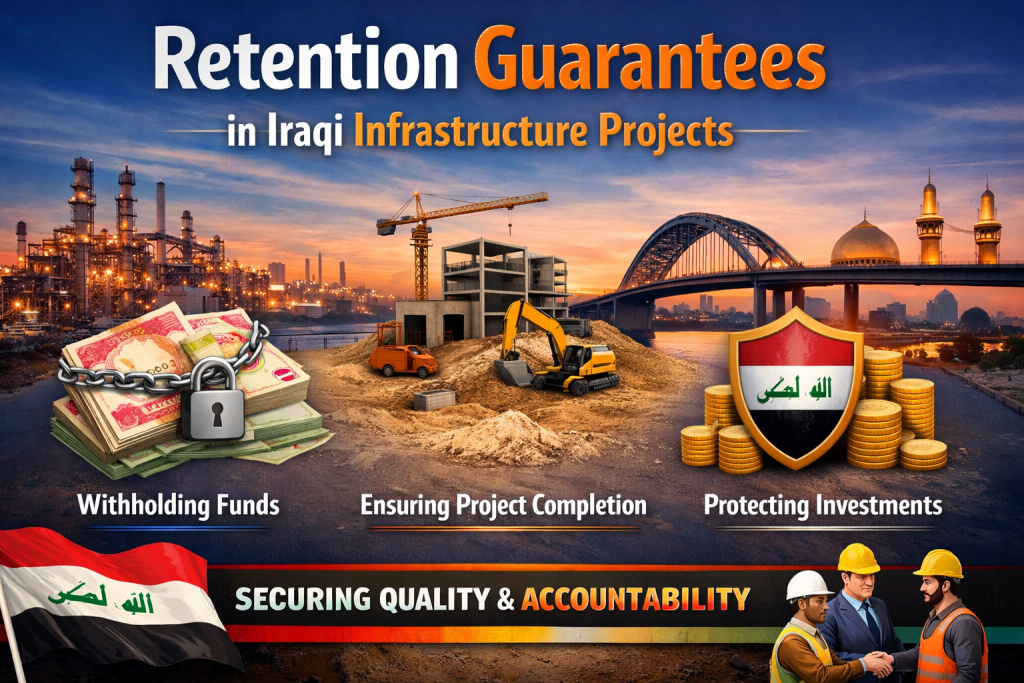
Retention Guarantees in Iraqi Infrastructure Projects Retention guarantees instruments that enable contractors to recover cash retention withheld by employers are an important but often overlooked element of construction finance in Iraq. In major infrastructure projects, employers typically withhold 5-10% of each progress payment as retention, until project completion and the expiry of the defects notification period. For contractors, this retained cash represents a significant financing cost. Retention guarantees allow contractors to replace withheld cash with a bank guarantee, freeing up working capital while providing the employer with equivalent security. This article examines the legal framework for retention guarantees in Iraqi infrastructure projects. The Purpose of Retention in Iraqi Construction Contracts Retention is the mechanism by which employers withhold a percentage of progress payments to create a financial incentive for contractors to complete the works and address defects. In Iraqi construction contracts both government contracts under Ministry of Planning forms and international contracts under FIDIC retention is typically set at 5-10% of the contract price, withheld at 50% during construction and the remaining 50% released upon completion of the defects notification period. For a contract worth USD 100 million, this means the employer holds USD 5-10 million of the contractor’s money for the full construction period and defects period potentially three to five years. The financing cost of this retention is substantial. How Retention Guarantees Work A retention guarantee allows the contractor to request release of the withheld cash retention upon providing a bank guarantee of equivalent value. The employer releases the cash retention to the contractor; in exchange, the contractor provides a retention money guarantee securing the employer’s right to make deductions from the retention for example, to cover the cost of remedying defects that the contractor fails to address. The retention guarantee typically remains in place until the end of the defects notification period, at which point it is cancelled if no valid call has been made. For contractors, the financing benefit of releasing cash retention can be substantial transforming withheld cash into working capital available for other projects. FIDIC Provisions on Retention Guarantees FIDIC Red Book Sub-Clause 14.9 addresses the release of retention money and allows contractors to provide a guarantee in lieu of cash retention. The FIDIC approach requires: the retention guarantee to be in a form approved by the employer; the guarantee to remain in effect until the end of the defects notification period; and the employer to have the right to call the guarantee if the contractor fails to remedy notified defects. FIDIC 2017 editions contain updated provisions on retention and retention guarantees that are increasingly used in Iraq as international contractors introduce FIDIC 2017 terms to their projects. Ministry of Planning Requirements Iraqi government contracts under Ministry of Planning standard forms have specific provisions on retention that may differ from FIDIC. Key Ministry of Planning retention requirements include: the retention rate applicable to the specific contract type; the conditions under which cash retention is released typically upon substantial completion and certificate of taking over; whether retention guarantees are permitted as a substitute for cash retention not all Ministry of Planning forms permit this; and the form of retention guarantee required government entities may require a specific guarantee form issued by a licensed Iraqi bank. URDG 758 and Retention Guarantees Retention guarantees subject to URDG 758 benefit from the rules’ comprehensive framework for demand guarantees. Key URDG 758 provisions relevant to retention guarantees include: the guarantee is independent of the underlying contract the employer can call the guarantee without reference to the contractor’s position in any dispute about defects; the supporting statement requirement the employer’s demand must specify the defects that the contractor has failed to remedy; and the expiry mechanism the guarantee expires at the end of the defects notification period, providing the contractor with certainty about the duration of its exposure. Managing Retention Guarantee Risk Contractors managing retention guarantees in Iraqi infrastructure projects should: monitor the defects notification period carefully and ensure the guarantee is cancelled promptly upon expiry; respond to defect notifications promptly unaddressed defects create legitimate calling rights; maintain clear records of all defect notifications received and remediation actions taken; ensure that the guarantee amount reduces as defects are certified as remedied where the contract permits partial release; and address disputes about defect liability promptly through the contract’s dispute resolution mechanism rather than allowing them to escalate to guarantee calls. How Etihad Law Firm Assists Etihad advises contractors and employers on retention guarantee arrangements in Iraqi infrastructure projects, drafts retention guarantee documentation compliant with URDG 758 and applicable contract requirements, advises on disputes arising from retention guarantee calls, and represents clients in construction arbitration involving retention and defects liability issues.
Counter-Guarantees in Iraqi Cross-Border Transactions

Counter-Guarantees in Iraqi Cross-Border Transactions Counter-guarantees are an essential mechanism for facilitating cross-border commercial transactions involving Iraq. When a foreign contractor or company needs to provide a bank guarantee to an Iraqi beneficiary but its relationship bank is a foreign institution, the counter-guarantee structure allows the foreign bank to issue a counter-guarantee to an Iraqi correspondent bank, which then issues the local guarantee in favour of the Iraqi beneficiary. This structure bridges the gap between the Iraqi requirement for a local bank guarantee and the foreign company’s banking relationships outside Iraq. This article examines the counter-guarantee framework applicable to Iraqi transactions under URDG 758 and CBI requirements. What is a Counter-Guarantee? A counter-guarantee is an independent undertaking issued by a bank (the counter-guarantor typically the foreign company’s home bank) in favour of another bank (the guarantor, the Iraqi correspondent bank), securing the counter-guarantor’s obligation to reimburse the guarantor if the guarantor is required to pay under the local guarantee it has issued to the beneficiary. The structure creates two independent instruments: the local guarantee issued by the Iraqi bank in favour of the Iraqi beneficiary; and the counter-guarantee issued by the foreign bank in favour of the Iraqi bank. Both instruments are independent of each other and of the underlying commercial transaction. URDG 758 Counter-Guarantee Framework URDG 758 provides a comprehensive framework for counter-guarantees in its Articles 1-5 and throughout the rules. Key provisions include: the independence principle applies fully to counter-guarantees, the counter-guarantor’s obligation to reimburse the guarantor is independent of both the local guarantee and the underlying transaction; the guarantor that receives a compliant demand under the local guarantee is entitled to demand reimbursement from the counter-guarantor; the counter-guarantor has the same five business day examination period for demands received from the guarantor; and the counter-guarantee must comply with all applicable URDG 758 requirements regarding form, demand mechanics, and expiry. CBI Requirements for Counter-Guarantees Iraqi banks accepting counter-guarantees from foreign banks must comply with CBI requirements regarding: correspondent banking, the foreign bank issuing the counter-guarantee must be an approved correspondent of the Iraqi bank, meeting the CBI’s correspondent banking due diligence standards; credit limits the total exposure to a single foreign bank under counter-guarantee arrangements is subject to the CBI’s single counterparty exposure limits; AML requirements, the Iraqi bank must conduct AML due diligence on the foreign bank and the underlying transaction; capital treatment counter-guarantees backed by approved foreign bank counter-guarantees receive specified treatment for capital adequacy purposes; and reporting Iraqi banks must report their counter-guarantee exposures to the CBI. The Practical Mechanics of a Counter-Guarantee Transaction A typical counter-guarantee transaction involving an Iraqi project proceeds as follows: the Iraqi project owner requires a performance guarantee from the foreign contractor; the foreign contractor instructs its home bank to arrange the guarantee; the home bank (counter-guarantor) issues a counter-guarantee to the Iraqi correspondent bank (guarantor); the Iraqi correspondent bank issues the local performance guarantee in favour of the Iraqi project owner; the Iraqi project owner calls the local guarantee if it believes the contractor has defaulted; the Iraqi bank pays the project owner and calls the counter-guarantee from the foreign home bank; and the foreign home bank reimburses the Iraqi bank under the counter-guarantee and seeks reimbursement from the contractor under the counter-indemnity. Risk Allocation in Counter-Guarantee Structures Counter-guarantee structures create distinct risk allocation issues: the foreign counter-guarantor bears the risk that the Iraqi guarantor bank will pay under the local guarantee even where the demand was fraudulent or non-compliant because the Iraqi bank’s payment obligation is independent; the foreign counter-guarantor should therefore include provisions in the counter-guarantee allowing it to challenge non-compliant demands from the Iraqi bank; the Iraqi bank bears operational risk in the examination of the local demand if it pays against a non-compliant demand, it may not be able to recover from the counter-guarantor; and both banks face the risk of fraud in the underlying transaction. Structuring Counter-Guarantees — Key Drafting Points Effective counter-guarantee documentation should address: the independence of the counter-guarantee from the local guarantee and the underlying transaction; the demand requirements what the Iraqi bank must present to the foreign bank to obtain reimbursement; the examination period and preclusion rules aligned with URDG 758; expiry the counter-guarantee expiry must be at least as long as the local guarantee expiry, plus a reasonable period for the Iraqi bank to present its demand; governing law and jurisdiction English law and London arbitration are commonly used for counter-guarantees involving international banks; and the currency of payment under the counter-guarantee typically USD or EUR, matching the currency of the local guarantee. How Etihad Law Firm Assists Etihad advises foreign companies and their banks on structuring counter-guarantee arrangements for Iraqi transactions, reviews counter-guarantee documentation for compliance with URDG 758 and CBI requirements, advises Iraqi correspondent banks on their obligations and rights under counter-guarantee structures, and represents clients in disputes arising from counter-guarantee calls.
Unfair Calling of Guarantees in Iraq

Unfair Calling of Guarantees in Iraq The independence of a bank guarantee from the underlying contract the feature that makes it commercially powerful also creates a significant risk for principals: the beneficiary may make a call in circumstances where no genuine breach has occurred, or may manufacture a pretext for demand. In Iraq, as in all jurisdictions, principals facing unfair guarantee calls have legal remedies but those remedies must be exercised with extreme speed. This article examines the legal framework for challenging unfair guarantee calls in Iraq, the remedies available before Iraqi courts, and the practical steps that principals must take immediately upon learning of an improper demand. What Constitutes an Unfair Call in the Iraqi Context An unfair or abusive guarantee call in the Iraqi context occurs where: the beneficiary makes a demand knowing that no breach of the underlying contract has occurred; the demand is made for a purpose unrelated to the security function of the guarantee; for example, as a commercial pressure tactic during a contract dispute; the demand is made for an amount exceeding the actual loss or the guaranteed amount; the underlying obligation has already been fulfilled and the guarantee should have been released; or the demand contains false information in the supporting statement required under URDG 758. In Iraq’s construction sector where disputes between government entities and contractors are common improper guarantee calls are a recognised risk that contractors must be prepared to address. The Fraud Exception Under Iraqi Law Iraqi civil law recognises the principle that courts may intervene in contractual arrangements where there is fraud (ghash) or abuse of rights. Applied to bank guarantees, this means that a court may restrain payment under an on-demand guarantee where the beneficiary is acting fraudulently. The fraud exception in the Iraqi context requires: evidence that the beneficiary knows there is no legitimate basis for the demand not merely a disputed commercial claim; the fraud must be clear and established, not merely alleged; and the application must be made before the bank pays urgency is absolute. Iraqi courts applying civil law principles may have a somewhat broader conception of what constitutes sufficient grounds for intervention than common law courts, but the threshold remains high. Seeking an Injunction Before Iraqi Courts — The Process The process for seeking an injunction to restrain guarantee payment before Iraqi courts involves: immediate legal consultation as soon as the principal learns of the guarantee call, it must consult Iraqi legal counsel with experience in urgent court applications; preparation of the application, the legal team prepares an urgent injunction application (talab isti’jali) supported by evidence of the alleged fraud or abuse; filing with the competent court, the application is filed with the commercial court having jurisdiction over the matter typically the court in the governorate where the issuing bank is located; the court reviews the application ideally on an urgent basis and initially without notice to the beneficiary (ex parte); if granted, the court order is served on the issuing bank restraining payment pending a full hearing; and the full hearing, the court hears arguments from both parties and decides whether to maintain or lift the injunction. Evidence Required for an Injunction Application The strength of an injunction application depends entirely on the evidence available. The principal should gather and present: documentation proving that the contractual obligation was performed, completion certificates, handover records, engineer’s certifications, and any other evidence of performance; evidence that the demand is false; for example, where the beneficiary’s supporting statement contains factually incorrect claims that can be disproved by documentation; any communications between the parties acknowledging performance or agreeing to extend the contract rather than terminate; and expert evidence where technical performance is disputed, an expert report confirming that works conform to specification can be powerful supporting evidence. The standard of evidence required is high: suspicion and commercial dispute alone are insufficient. Remedies After Payment Where the bank has already paid under the guarantee before an injunction can be obtained, the principal’s remedies shift from preventing payment to recovering amounts paid. Available remedies include: claims for damages against the beneficiary for wrongful calling of the guarantee pursued through Iraqi courts or arbitration under the underlying contract; claims for unjust enrichment where the beneficiary has received payment to which it was not entitled; and set-off of amounts paid against other obligations owed by the beneficiary to the principal under the contract. Recovery through these mechanisms is possible but typically slower and less certain than preventing payment through an injunction. Preventive Measures — Reducing the Risk at the Drafting Stage The best protection against unfair guarantee calls is careful drafting at the outset. Contractors in Iraqi projects should: insist on URDG 758 governance, the supporting statement requirement provides a layer of protection against groundless demands; negotiate pre-call notification requirements in the underlying contract, the employer must notify the contractor of the alleged breach and allow a cure period before calling the guarantee; include dispute resolution provisions requiring arbitration of the underlying dispute before or concurrent with any guarantee call; ensure the guarantee clearly defines the specific obligations it secures vague guarantee descriptions create broader calling rights; and negotiate the guarantee amount to be proportionate to the actual risk being secured. How Etihad Law Firm Assists Etihad has experience acting for contractors facing unfair guarantee calls in Iraq. We move swiftly to assess the viability of injunctive relief, prepare urgent court applications, coordinate with the principal’s bank, and pursue post-payment recovery against beneficiaries who have called guarantees wrongfully. We also advise proactively on guarantee terms to minimise unfair call risk.
Bid Bonds in Iraqi Public Tenders

Bid Bonds in Iraqi Public Tenders Bid bonds also known as tender guarantees are mandatory security instruments in Iraq’s public procurement system. Before a contractor can participate in a public tender in Iraq, it must provide a bid bond securing its obligation to: maintain its bid during the tender period; execute the contract if awarded; and provide any required performance guarantee upon contract award. For contractors competing for Iraqi government contracts, a market worth billions of dollars annually understanding the legal requirements for bid bonds, how they are structured, and the risks they create is fundamental to successful tender participation. The Legal Basis for Bid Bonds in Iraq The requirement for bid bonds in Iraqi public tenders is established by the Federal Acquisitions Law and implementing regulations administered by the Prime Minister’s Office. The law requires all government entities to demand bid securities from tenderers above specified contract value thresholds. Ministerial instructions specify the form, amount, and validity period of required bid securities. The specific requirements vary by ministry and contract type contractors must review the tender documents for each specific procurement to understand the exact bid bond requirements applicable. Bid Bond Requirements — Amount and Validity Bid bond requirements in Iraqi public tenders typically include: amount bid bonds are typically required in an amount equal to 1-3% of the estimated contract value; validity, the bid bond must remain valid for the full tender validity period, which in Iraqi practice is typically 90-180 days from the tender submission deadline; automatic extension if the tender period is extended, contractors must arrange corresponding extensions to their bid bonds; and form the bid bond must be in the form specified in the tender documents, issued by a licensed Iraqi bank or an approved foreign bank. URDG 758 and Tender Guarantees URDG 758 provides specific provisions for tender guarantees in Article 14, recognising the unique characteristics of this instrument. Key URDG 758 provisions for tender guarantees include: automatic termination, the tender guarantee automatically terminates when the tender validity period expires without award, without requiring return of the guarantee instrument; termination upon contract signing, the guarantee terminates when the successful tenderer signs the contract and provides the required performance security; and demand requirements any demand under a tender guarantee must specify that the tenderer has breached its tender obligations, providing a degree of protection against arbitrary calls. When Can a Bid Bond Be Called? A bid bond can legitimately be called in the following circumstances: the tenderer withdraws its bid during the tender validity period after submission; the tenderer fails to execute the contract within the specified period after notification of award; the tenderer fails to provide the required performance guarantee within the specified period after award; or the tenderer otherwise breaches its obligations under the tender conditions. A bid bond cannot legitimately be called simply because the tenderer was unsuccessful losing a tender does not trigger a call. Contractors should be aware that improper calls particularly after unsuccessful bids do occur in practice and require urgent legal response. Bid Bond Management for Iraqi Tender Participants Contractors participating in Iraqi public tenders should implement the following bid bond management practices: maintain an adequate banking facility for bid bonds participating in multiple tenders simultaneously requires significant guarantee capacity; monitor tender validity periods and ensure bid bonds remain valid throughout expired bid bonds may disqualify the contractor from the tender; arrange extensions promptly when tender periods are extended government entities are strict about bid bond validity; record all bid bonds issued and their expiry dates centrally; and ensure bid bonds are cancelled and returned promptly after unsuccessful tenders or contract execution unnecessary bid bonds tie up banking capacity. Foreign Contractors in Iraqi Tenders Foreign contractors bidding for Iraqi government contracts face specific bid bond requirements. Iraqi tender documents typically require bid bonds from licensed Iraqi banks, foreign bank guarantees are not always accepted. Foreign contractors must therefore arrange for an Iraqi bank to issue the local bid bond, backed by a counter-guarantee from the contractor’s bank in its home jurisdiction. This counter-guarantee structure requires: the foreign contractor’s bank to issue a counter-guarantee to the Iraqi bank; the Iraqi bank to issue the local bid bond to the Iraqi government entity; and the foreign contractor to provide its bank with adequate collateral or facility coverage. The counter-guarantee arrangement takes time to set up foreign contractors should initiate the process well before the tender submission deadline. How Etihad Law Firm Assists Etihad advises contractors on bid bond requirements for Iraqi public tenders, assists in structuring counter-guarantee arrangements for foreign contractors, advises on responding to improper bid bond calls, and represents contractors in disputes with government entities arising from tender guarantee issues.
Advance Payment Guarantees in Iraqi Government Contracts
Advance Payment Guarantees in Iraqi Government Contracts Advance payment guarantees also known as advance payment bonds are among the most commonly required security instruments in Iraqi government contracting. When an Iraqi government entity makes an advance payment to a contractor to mobilise for a project, it requires an advance payment guarantee to secure the return of those funds if the contractor fails to perform and earn the advance through completed works. For contractors working in Iraq, understanding the legal framework for advance payment guarantees and managing the risks they create is essential commercial knowledge. The Purpose and Mechanics of Advance Payment Guarantees Advance payment guarantees secure the government entity’s right to recover advance payments made to contractors before work is completed. The mechanism is straightforward: the contractor receives an advance typically 10-20% of the contract price to fund mobilisation, purchase materials, and commence work; simultaneously, the contractor provides an advance payment guarantee for the full advance amount; as the contractor completes work and submits certified progress payments, the advance is recouped by reducing progress payment amounts; and the advance payment guarantee reduces proportionally as the advance is recouped, until it is extinguished when the full advance has been earned. Iraqi Government Contract Requirements Iraqi government contracting regulations administered by the Prime Minister’s Office (PMO) and individual ministries require advance payment guarantees for all contracts where advance payments are made. Key requirements under Iraqi government contract frameworks include: the advance payment guarantee must be issued by a licensed Iraqi bank; the guarantee amount must equal the full amount of the advance payment; the guarantee must be valid until the full advance is recouped through certified works; the guarantee must be in the form specified in the contract typically a demand guarantee rather than a conditional guarantee; and the guarantee must be submitted before the advance payment is released. URDG 758 Application to Advance Payment Guarantees URDG 758 provides specific guidance relevant to advance payment guarantees. The automatic reduction mechanism whereby the guarantee amount reduces automatically as the advance is recouped must be carefully documented in the guarantee instrument. The guarantee should specify: the initial advance amount; the mechanism for reduction typically by reference to certified payment certificates; and the minimum documentation required to effect each reduction. Clear drafting of the reduction mechanism is critical: ambiguity about when and how the guarantee reduces creates disputes between the contractor, the government entity, and the issuing bank. The Risk of Disproportionate Calling A significant risk for contractors in Iraqi government contracts is the calling of the full advance payment guarantee even where the contractor has partially earned the advance through completed works. If the advance has been partially recouped but the guarantee has not been formally reduced, the government entity may attempt to call the full original guarantee amount recovering more than the unearned advance. To mitigate this risk, contractors should: ensure the guarantee reduction mechanism is automatic and document-triggered rather than requiring separate bank instructions; request periodic formal reductions as certified works are completed; and maintain clear records of advance recoupment amounts. Practical Management During Project Execution Effective management of advance payment guarantees during project execution requires: tracking advance recoupment at every progress payment cycle and ensuring the guarantee is reduced accordingly; engaging proactively with the government entity’s engineer or project manager to agree on certified payment values that accurately reflect completed works; addressing any disputes about certified values early disputed certifications that delay advance recoupment effectively extend the guarantee exposure; and ensuring that the guarantee expiry date is adequately extended if the contract is extended, to avoid the guarantee expiring while the advance remains partly unearned. Tax and Accounting Treatment Advance payment guarantees have specific accounting implications for both contractors and government entities. For contractors, the guarantee fee paid to the issuing bank is a project cost deductible for Iraqi tax purposes. The advance received is not income but a liability that reduces as earned through completed works. For government entities, the advance payment guarantee is a contingent asset that provides security over the advance. Under IFRS which some larger Iraqi entities apply the treatment of advance payment guarantees requires careful consideration as financial instruments. How Etihad Law Firm Assists Etihad advises contractors and government entities on advance payment guarantee arrangements in Iraqi government contracts, drafts guarantee instruments with clear reduction mechanisms, advises on disputes arising from advance payment guarantee calls, and represents contractors in urgent proceedings to challenge improper calls.
Performance Guarantees in Iraqi Construction Contracts

Performance Guarantees in Iraqi Construction Contracts Performance guarantees are a fundamental requirement of construction contracting in Iraq. Whether under international FIDIC-based contracts with major project owners or under standard Ministry of Planning contract forms for government projects, contractors are required to provide bank-issued performance guarantees securing their obligation to complete the contracted works. The performance guarantee is the employer’s primary protection against contractor default and for contractors, it represents a significant financial commitment and a legal risk that must be carefully managed. This article examines the legal framework, documentation requirements, and practical management of performance guarantees in Iraqi construction contracts. The Role of Performance Guarantees in Iraqi Construction Performance guarantees in Iraqi construction serve a dual purpose: providing the employer with a reliable financial remedy in the event of contractor default, without the need for lengthy dispute resolution proceedings; and incentivising the contractor to perform by placing significant financial value at risk. In Iraq’s construction sector where the majority of large-scale infrastructure and government projects involve significant advance payments, long contract periods, and the risk of contractor financial difficulty performance guarantees are indispensable. Iraqi government contracting regulations require performance guarantees for all contracts above specified value thresholds. FIDIC Contract Requirements The FIDIC suite of contracts particularly the Red Book (Construction), Yellow Book (Plant and Design-Build), and Silver Book (EPC/Turnkey) is widely used for major construction projects in Iraq, including those financed by international development institutions and involving international contractors. Under FIDIC Sub-Clause 4.2, the contractor is required to provide a performance security in an amount specified in the contract data typically 5-10% of the contract price. FIDIC requires the performance security to be in the form of an unconditional bank guarantee or surety bond from an approved bank or surety. FIDIC 2017 editions also require the employer to provide a payment guarantee under Sub-Clause 2.6 in certain circumstances. Ministry of Planning Standard Contract Requirements For Iraqi government construction contracts governed by Ministry of Planning standard forms, performance guarantee requirements are specified in the contract conditions. Key features of Ministry of Planning performance guarantee requirements include: the guarantee must be issued by a licensed Iraqi bank or, for international contractors, by a foreign bank with a corresponding Iraqi bank counter-guarantee; the guarantee amount is typically 5-10% of the contract price; the guarantee must remain valid for the full contract period plus a defects notification period; and the guarantee must be in the standard form specified by the Ministry of Planning, which may differ from URDG 758 standard forms. URDG 758 and Performance Guarantees Performance guarantees issued under URDG 758 provide a clear framework for both the issuance and the calling of the guarantee. Key URDG 758 provisions relevant to performance guarantees include: the supporting statement requirement, any demand must include a statement specifying in what respect the contractor has failed to perform its obligations under the construction contract; this requirement provides contractors with a degree of protection against groundless demands, as the employer must at least articulate the alleged breach; the extend or pay provision, commonly invoked in construction projects where the contractor’s program is delayed, giving the employer the right to either extend the guarantee or receive payment; and the independence principle, the bank pays against a compliant demand regardless of any dispute between employer and contractor about whether a breach has actually occurred. Managing Performance Guarantee Risk as a Contractor Contractors in Iraqi construction projects should implement the following risk management strategies for performance guarantees: negotiate URDG 758 governance ensuring the supporting statement requirement applies and provides some protection against unfair calls; negotiate the guarantee amount pushing back on excessive guarantee percentages that tie up significant banking capacity; ensure the expiry date is clearly defined and aligned with the contract completion date plus defect notification period; include cure period provisions in the construction contract requiring the employer to notify the contractor of alleged breach and allow a cure period before calling the guarantee; maintain close communication with the employer to identify potential default situations early; and ensure adequate counter-indemnity arrangements with the bank that do not over-collateralise the contractor’s assets. Calling and Responding to Performance Guarantee Calls When an employer calls a performance guarantee in an Iraqi construction project, the contractor must act immediately. Steps include: reviewing the demand notice to assess whether it complies with URDG 758 requirements, a non-compliant demand can be refused by the bank; assessing whether there are grounds to challenge the call through injunction proceedings before Iraqi courts or arbitration under the construction contract; engaging with the employer to negotiate a resolution, employers sometimes make guarantee calls as a negotiating tactic rather than as a genuine enforcement action; and notifying the contractor’s bank which will decide whether to pay or seek instructions before the five business day examination period expires. How Etihad Law Firm Assists Etihad advises contractors and employers on performance guarantee arrangements in Iraqi construction contracts, drafts and reviews guarantee terms for compliance with URDG 758 and Ministry of Planning requirements, advises on responses to guarantee calls, and represents contractors in urgent injunction proceedings and construction arbitration involving performance guarantee disputes.
Bank Guarantees in Iraq

Bank Guarantees in Iraq Bank guarantees are among the most widely used financial instruments in Iraq’s commercial, construction, and government contracting sectors. From construction performance bonds to advance payment securities and public tender bid bonds, guarantees underpin a vast range of Iraqi commercial transactions. Yet the legal framework governing bank guarantees in Iraq combining Iraqi Civil Code provisions, CBI regulatory instructions, and internationally recognised rules under URDG 758 presents complexity that both banks and their clients must navigate carefully. This article provides a comprehensive guide to the bank guarantee framework in Iraq. The Iraqi Civil Code Framework for Guarantees The Iraqi Civil Code provides the foundational legal framework for suretyship and guarantee arrangements in Iraq. Articles 1007 to 1061 of the Civil Code govern kafala (suretyship) the obligation of a guarantor to answer for the debt or obligation of a principal debtor. Traditional Iraqi civil law kafala is an accessory obligation it follows the principal obligation and the surety can raise defences available to the principal debtor. However, bank guarantees issued in commercial contexts particularly international transactions are structured as independent demand guarantees rather than accessory suretyship arrangements, specifically to avoid the limitations of the accessory kafala framework. The independence of commercial bank guarantees from the underlying obligation is recognised in Iraqi commercial practice. CBI Instructions on Guarantee Issuance The CBI regulates the issuance of guarantees by Iraqi licensed banks through specific instructions addressing: guarantee limits the total guarantee exposure of an Iraqi bank to a single counterparty is subject to single exposure concentration limits as a percentage of the bank’s capital; documentation requirements, banks must maintain complete files for all guarantees issued, including the counter-indemnity from the applicant, the guarantee instrument, and all amendments; collateral requirements banks typically require cash collateral or other security from the applicant before issuing a guarantee, with the collateral amount depending on the applicant’s credit standing; reporting requirements, banks must report their guarantee portfolios to the CBI as part of periodic prudential reporting; and capital treatment guarantees are treated as off-balance sheet contingent liabilities with specified credit conversion factors for capital adequacy purposes under the CBI’s Basel III implementation. URDG 758 in Iraqi Guarantee Practice URDG 758 is the internationally recognised set of rules for demand guarantees and counter-guarantees, and its incorporation is increasingly standard in commercial bank guarantees issued by Iraqi banks. The key provisions of URDG 758 that are most relevant in the Iraqi context include: the independence principle, the guarantee is independent of the underlying contract and the guarantor pays against a compliant demand; the supporting statement requirement, any demand must include a statement by the beneficiary indicating in what respect the principal has breached its obligation; the five business day examination period, the guarantor has five business days to examine a demand and give notice of non-compliance; and extend or pay provisions providing a structured mechanism for beneficiary requests to extend the guarantee or receive payment. Counter-Indemnity — The Bank’s Protection Before issuing a guarantee, an Iraqi bank obtains a counter-indemnity from the applicant, the company or individual on whose behalf the guarantee is issued. The counter-indemnity is a binding commitment by the applicant to reimburse the bank for any amounts paid under the guarantee, plus costs and expenses. Counter-indemnities in Iraqi banking practice typically include: an unconditional obligation to reimburse upon demand without requiring proof of underlying breach; a charge over the applicant’s accounts with the bank; an assignment of proceeds of the guaranteed contract; and an obligation to maintain cash collateral at specified levels. Key Types of Guarantees in Iraqi Practice The most commonly issued bank guarantees in Iraq include: performance guarantees issued in favour of project owners and government entities to secure the contractor’s performance of construction and service contracts; advance payment guarantees securing the return of advance payments made to contractors under construction contracts; bid bonds (tender guarantees) required by government entities and project owners in public tender processes; retention money guarantees enabling contractors to release retention funds held by employers under construction contracts; and payment guarantees securing payment obligations under commercial contracts, particularly in trade and supply chain contexts. Iraqi Government Entities as Beneficiaries A significant proportion of bank guarantees issued by Iraqi banks are in favour of Iraqi government entities ministries, state-owned companies, and public authorities. Government entity guarantee requirements are typically specified in standard contract forms used by the relevant ministry or authority. Key considerations when issuing guarantees in favour of Iraqi government entities include: the exact wording required by the government entity must be followed government entities may reject guarantees that do not use their standard form; the expiry date must align with the contract duration; and calling procedures for government entity beneficiaries may differ from commercial practice legal advice should be obtained on the specific requirements of the relevant entity. How Etihad Law Firm Assists Etihad advises Iraqi banks and their corporate clients on all aspects of bank guarantee transactions from drafting guarantee terms compliant with CBI requirements and URDG 758, to advising on counter-indemnity documentation, to representing clients in disputes arising from guarantee calls. We have particular experience in guarantees for Iraqi government and public sector contracts.
LC Disputes in Iraq: Courts or Arbitration?

LC Disputes in Iraq: Courts or Arbitration? When a letter of credit transaction goes wrong whether through wrongful rejection of documents, non-payment by the issuing bank, or allegations of fraud the parties face an immediate question: where and how to resolve the dispute? In Iraq, as in other markets, the choice between pursuing claims before Iraqi courts and submitting to international arbitration has significant practical implications for the speed, cost, and likely outcome of dispute resolution. This article examines the options available for resolving LC disputes involving Iraqi parties, the relative merits of each, and the key considerations that should inform the choice of forum. The Nature of LC Disputes LC disputes arise in a variety of circumstances, including: wrongful rejection, the issuing or confirming bank refuses to pay despite the presentation of compliant documents; wrongful dishonour the bank fails to pay on time or refuses on grounds not supported by UCP 600; discrepancy disputes, parties disagree on whether specific documents are compliant; fraud disputes, one party alleges that documents are forged or that the presentation is fraudulent; and underlying contract disputes, the buyer claims the goods are defective or do not conform to the commercial contract. Each type of dispute has different characteristics that affect the appropriate forum choice. Iraqi Courts — Jurisdiction and Practice Iraqi courts have jurisdiction over LC disputes where: the issuing bank is licensed in Iraq; the LC transaction was performed in Iraq; or the parties have agreed to Iraqi court jurisdiction. Commercial disputes in Iraq are heard by the commercial courts specialised divisions of the civil courts with experience in commercial matters. Iraqi courts apply Iraqi law as the applicable substantive law for disputes before them, supplemented by UCP 600 provisions incorporated into the LC. Key practical considerations for Iraqi court proceedings include: proceedings are conducted in Arabic, foreign parties need qualified translators and Iraqi legal representation; the timeline for commercial court proceedings varies significantly; and enforcement of an Iraqi court judgment against a foreign party requires separate proceedings in the foreign jurisdiction. International Arbitration — ICC, LCIA, and DIFC-LCIA International arbitration is increasingly used to resolve trade finance disputes involving Iraqi parties, particularly where one or more parties are foreign. The most commonly used arbitral institutions for Iraq-related disputes include: International Chamber of Commerce (ICC), the most widely used institution for international commercial arbitration globally, with well-established procedures and a strong track record of enforcing awards; London Court of International Arbitration (LCIA) widely used for disputes involving English law-governed documents; and DIFC-LCIA, the arbitration centre in the Dubai International Financial Centre, increasingly popular for Middle East disputes due to its geographic proximity and the enforceability of its awards in the region. Iraq and the New York Convention Iraq acceded to the New York Convention on the Recognition and Enforcement of Foreign Arbitral Awards in 2008. This means that arbitral awards rendered in signatory states can be enforced in Iraq through the Iraqi courts, subject to the limited grounds for refusal specified in the Convention. In practice, enforcement of New York Convention awards in Iraq has worked, though the process requires filing an enforcement application with the competent Iraqi court. The availability of New York Convention enforcement is a significant advantage of international arbitration over foreign court judgments for parties dealing with Iraqi counterparties. Choosing the Right Forum — Key Considerations The choice between Iraqi courts and international arbitration for LC disputes should consider: the nature of the dispute straightforward document rejection disputes may be suitable for Iraqi courts; complex, high-value disputes benefit from international arbitration’s procedural sophistication; the nationality of the parties foreign parties typically prefer international arbitration to avoid perceived home court advantages; the governing law English law-governed LCs are better suited to English-seat arbitration or London courts; speed and cost Iraqi courts may offer faster resolution for straightforward matters, while arbitration provides more predictable procedures for complex disputes; and enforcement needs where the award must be enforced against assets in multiple jurisdictions, international arbitration with New York Convention enforcement provides the broadest reach. Drafting Effective Dispute Resolution Clauses Effective dispute resolution clauses in LC-related documents including the underlying commercial contract and any security documents should: specify the chosen arbitral institution and procedural rules clearly; designate the seat of arbitration; specify the number of arbitrators and selection mechanism; specify the governing law; address urgent interim relief specifying whether parties may seek emergency arbitrator relief or must go to national courts; and address confidentiality of proceedings. Ambiguous or poorly drafted dispute resolution clauses create jurisdictional disputes before the substantive dispute is even addressed. How Etihad Law Firm Assists Etihad represents clients in LC disputes before Iraqi commercial courts and in international arbitration proceedings. We advise on forum selection, draft effective dispute resolution clauses in trade finance documents, manage Iraqi court enforcement proceedings for foreign arbitral awards, and provide urgent advisory services when LC disputes arise.
Trade Finance Fraud in Iraq

Trade Finance Fraud in Iraq Trade finance fraud is a global problem, and Iraq as a major import market with a complex regulatory environment is not immune. From forged shipping documents and fictitious invoices to phantom shipments and duplicate financing fraud, the range of schemes targeting trade finance transactions is broad and constantly evolving. For Iraqi banks, importers, and their legal advisers, understanding the types of fraud that occur in the trade finance context, the legal remedies available under Iraqi law and international trade finance rules, and the prevention strategies that reduce vulnerability is essential. Common Forms of Trade Finance Fraud in Iraq The most common forms of trade finance fraud affecting Iraqi transactions include: document fraud — forging or altering shipping documents, invoices, certificates of origin, or inspection certificates to present a compliant presentation under an LC when the actual goods do not conform to LC terms or do not exist; phantom shipment presenting documents for goods that were never shipped, typically involving forged bills of lading; over-invoicing presenting inflated invoices to obtain LC payment exceeding the actual value of goods, often used to disguise capital flight; duplicate financing using the same goods or shipping documents to obtain financing from multiple banks simultaneously; and manipulation of inspection certificates bribing inspection agency personnel to certify non-conforming goods as compliant. The Fraud Exception Under UCP 600 UCP 600 is built on the principle of documentary independence banks pay against documents, not against the underlying transaction. However, all legal systems recognise a fraud exception: where the presentation of documents is clearly fraudulent meaning the beneficiary knows the documents are forged or that it has no legitimate claim, a court may restrain the bank from paying. The fraud exception under UCP 600 is narrow: it requires clear, established fraud, not merely allegations or suspicion. A disputed commercial transaction where the goods are delivered but the importer claims they are substandard does not constitute fraud for LC purposes. Iraqi Legal Remedies for Trade Finance Fraud Iraqi law provides several remedies for victims of trade finance fraud. Under the Iraqi Penal Code, forgery of commercial documents is a criminal offence punishable by imprisonment. Iraqi banks and companies that discover document fraud should file criminal complaints with the competent Iraqi investigative authorities. Civil remedies include: claims for damages against the fraudulent party; injunctive relief to restrain LC payment where fraud is established; and recovery of funds paid under fraudulently obtained LCs through civil court proceedings. Iraqi courts have jurisdiction over fraud claims where: the fraud was committed in Iraq; the fraudulent party is located in Iraq; or the bank that made payment is licensed in Iraq. Injunctions to Restrain LC Payment — Iraqi Court Practice Where an Iraqi bank or importer discovers document fraud before payment is made under an LC, an urgent injunction application may be filed with the competent Iraqi court to restrain payment. Iraqi courts may grant interim injunctions restraining bank payment where there is credible evidence of fraud and the balance of convenience favours restraint. The applicant must act immediately, once the bank has paid, injunctive relief is academic. The applicant must provide the court with clear documentary evidence of fraud, not merely allegations based on commercial suspicion. Iraqi courts’ approach to LC injunctions is developing, and the outcome of applications depends significantly on the strength of evidence and the competence of legal representation. AML Implications of Trade Finance Fraud Trade finance fraud frequently intersects with AML violations. Over-invoicing, phantom shipments, and duplicate financing are used not only for direct financial gain but also as mechanisms for money laundering moving illicit funds across borders disguised as legitimate trade transactions. Iraqi banks are required under AML Law No. 39 of 2015 and CBI AML instructions to implement trade finance-specific AML controls, including: transaction monitoring for unusual LC patterns; enhanced due diligence on high-risk counterparties and jurisdictions; verification of the economic rationale of trade transactions; and cross-referencing of LC documentation against independent commercial databases. Prevention Strategies for Iraqi Banks and Traders Prevention of trade finance fraud requires a multi-layered approach: banks should implement pre-shipment inspection requirements for high-risk transactions and goods; independent verification of shipping documents through reputable inspection agencies; automated duplicate financing detection systems; enhanced due diligence on first-time customers and unfamiliar counterparties; staff training on document fraud detection; and information sharing with other banks and the CBI on identified fraud patterns. Traders should conduct thorough due diligence on their counterparties, use reputable freight forwarders, and consider using confirmed LCs where the issuing bank’s document examination quality is uncertain. How Etihad Law Firm Assists Etihad advises Iraqi banks and companies on legal remedies for trade finance fraud, including urgent injunction applications, criminal complaints, and civil recovery proceedings. We also advise on AML compliance frameworks for trade finance and on due diligence procedures to reduce fraud vulnerability.