
Types of Commercial Law in Iraq: A Complete Guide for Businesses
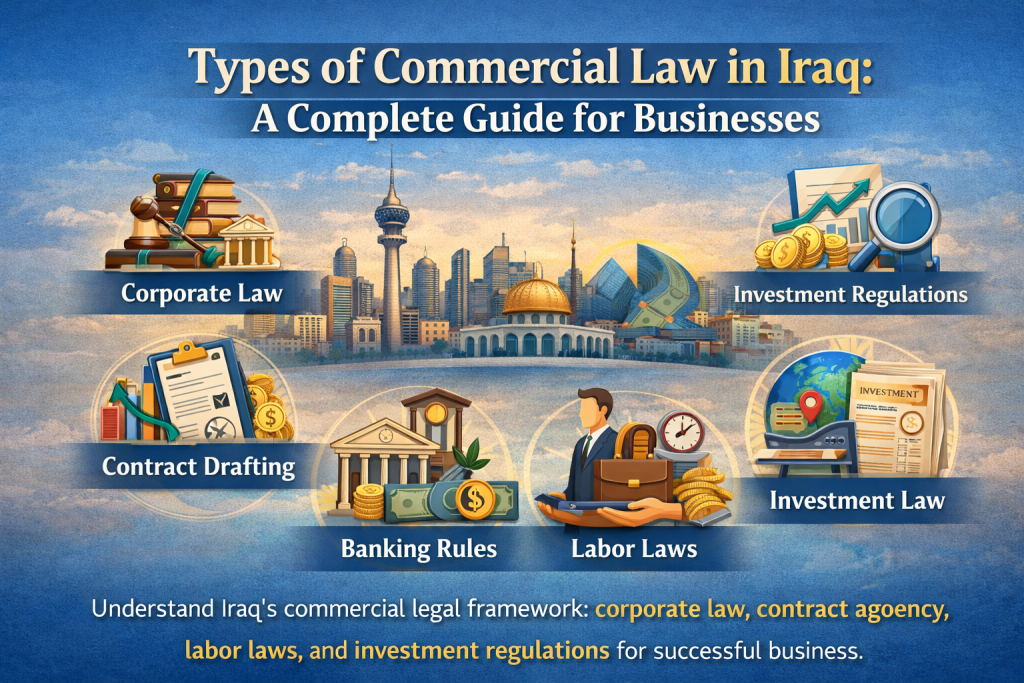
As the economy of Iraq continues to diversify beyond oil, the country is increasingly attracting foreign investors and supporting the growth of its private sector. With expanding infrastructure projects, trade opportunities, and government reforms, Iraq is positioning itself as an emerging destination for regional and international business. However, operating successfully in this environment requires a clear understanding of commercial law in Iraq. Legal compliance is essential for company registration, contract enforcement, taxation, and employment practices. Both local entrepreneurs and foreign companies must navigate a range of regulations that govern business operations. This includes corporate law, contract law, investment regulations, banking rules, and labor laws—each forming a critical part of the broader commercial legal framework in Iraq.
Commercial law in Iraq is primarily governed by the Iraqi Code of Commerce No. 30 of 1984 and the Iraqi Civil Code No. 40 of 1951, covering commercial contracts, agency, and business operations. It mandates that commercial agencies, including franchises and distribution agreements, be registered under Law No. 79 of 2017 to be legally enforceable.
Key aspects of Iraqi commercial law include:
- Commercial Agency Law (No. 79 of 2017): Regulates relationships between foreign companies and local agents, requiring registration with the Ministry of Trade.
- Law of Commerce No. 30 of 1984: Regulates commercial contracts, ledgers, marine businesses, and illegal competition.
- Contracting & Corporate Entity: Contracts require offer, acceptance, and lawful intent. The law allows for foreign companies to operate, but often through a local registered agent or by forming a registered subsidiary.
- Company Structure: Companies are governed by the Companies Law, which allows for limited liability companies (LLCs) and branch offices.
- Investment Law No. 13 of 2006: Provides foreign investors with potential incentives, including tax exemptions for up to 10 years.
- Dispute Resolution: Arbitration is permitted and frequently preferred in cross-border commercial contracts, according to Chambers and Partners and Chambers and Partners.
Key legislation includes the Civil Code (1951) for general contractual principles and the Commercial Code (1984) for specific business transactions.
Key Sources of Commercial Law in Iraq
The framework of commercial law in Iraq is derived from several key legislative instruments that collectively regulate business activities and commercial transactions. These laws work together to create a structured legal environment for both domestic and international businesses.
Primary Legislative Sources
- Iraqi Commercial Code
Governs trade practices, commercial contracts, negotiable instruments, and the legal obligations of merchants. It forms the backbone of day-to-day commercial transactions in Iraq. - Companies Law No. 21 of 1997
Regulates company formation, corporate governance, shareholder rights, and business dissolution. It establishes the legal identity and operational structure of companies. - Investment Law No. 13 of 2006
Provides incentives and legal protections to both foreign and domestic investors, encouraging economic development and foreign direct investment.
Regulatory Authorities and Oversight
- Ministry of Trade
Oversees company registration, commercial licensing, and trade regulations. - Central Bank of Iraq
Issues related to financial, banking, and monetary regulations affecting business transactions, foreign exchange, and financial compliance.
Together, these statutes and regulatory bodies form a comprehensive and interconnected legal framework that governs commercial operations, protects investors, and ensures market stability in Iraq.
Here is a refined and SEO-enhanced version of your section with better structure, smoother flow, and added bullet points for clarity while keeping it professional and suitable for publication.
Companies Law and Corporate Governance in Iraq
The cornerstone of corporate regulation in Iraq is the Companies Law No. 21 of 1997, as amended. This legislation establishes the legal framework for company formation, governance, and dissolution, making it one of the most important components of commercial law in Iraq. It applies to both domestic companies and certain foreign business entities operating within the country.
Types of Companies Recognized
Under this law, several types of business structures are permitted, allowing entrepreneurs and investors to choose a model that aligns with their operational and financial objectives:
- Limited Liability Companies (LLCs)
- Joint-Stock Companies
- Partnerships
- Sole Proprietorships
Each structure carries different requirements regarding minimum capital, liability exposure, ownership, and management control.
Shareholder Rights and Corporate Governance
The law clearly defines shareholder rights and responsibilities, including:
- Voting powers in company decisions
- Entitlement to dividends and profit distribution
- Liability for company debts limited to the value of their shares
To promote transparency and accountability, corporate governance provisions require companies to:
- Maintain accurate financial records
- Conduct regular shareholder meetings
- Comply with reporting and disclosure obligations
Company Registration Process
The company registration process is administered by the
Companies Registration Office under the
Ministry of Trade.
Businesses must:
- Submit incorporation documents
- Obtain necessary approvals
- Complete formal registration before commencing operations
This process ensures legal recognition, regulatory compliance, and operational transparency for all registered entities in Iraq.
Contract Law and Commercial Agreements
Contracts form the backbone of commercial law in Iraq, as they define the rights, obligations, and expectations of parties engaged in business transactions. The legal framework governing contracts is primarily derived from the Iraqi Civil Code and the Iraqi Commercial Code, which together regulate how commercial agreements are formed, interpreted, and enforced.
Common types of agreements used in Iraqi business practice include sale agreements for the transfer of goods, service contracts for professional and technical services, and agency or distribution agreements that authorize third parties to represent or sell products on behalf of a company. These contracts must clearly outline payment terms, delivery obligations, liability clauses, and dispute resolution mechanisms.
Importantly, contracts that meet the legal requirements of offer, acceptance, and lawful consideration are generally enforceable before the Iraqi courts. By providing a structured and enforceable framework, contract law helps protect business relationships, reduce misunderstandings, and ensure that parties can seek legal remedies if agreements are breached.
Here is a refined version of your section with improved structure, readability, and SEO while keeping it professional and suitable for publication.
Trade and Commercial Transactions Law
Trade and commercial transactions in Iraq are primarily regulated by the Iraqi Commercial Code, which establishes the legal rules governing day-to-day business dealings between merchants. This area of commercial law in Iraq plays a central role in ensuring that commercial activities are conducted in a structured, predictable, and legally enforceable manner.
Regulation of Commercial Sales
The law governs the buying and selling of goods by requiring commercial sales contracts to clearly define:
- Delivery terms and timelines
- Pricing and payment conditions
- Liability and risk transfer between parties
These provisions help prevent disputes and ensure that both buyers and sellers understand their legal obligations before entering into transactions.
Negotiable Instruments and Commercial Payments
The Commercial Code also regulates negotiable instruments such as cheques and promissory notes, which are widely used in Iraqi business transactions as reliable tools for payment and credit. The law outlines specific requirements for their issuance, endorsement, and enforcement, providing legal certainty in financial dealings.
By establishing clear obligations between merchants and standardized procedures for payments and trade, this legal framework helps maintain trust, predictability, and operational efficiency across Iraq’s commercial sector.
Foreign Investment and Investment Protection Laws
Foreign investment in Iraq is primarily governed by the Investment Law No. 13 of 2006, which was introduced to attract international capital and promote economic development across various sectors. This law forms a key part of commercial law in Iraq, providing a legal framework that supports both foreign and domestic investors.
One of the major advantages offered under this law is a range of incentives for foreign investors, including tax exemptions for specified periods and customs duty relief on imported equipment and materials used in approved projects. The law also established the National Investment Commission, which is responsible for facilitating investment approvals, issuing licenses, and coordinating with regional investment bodies.
Importantly, the legislation provides legal protections against expropriation or nationalization without fair compensation, offering investors greater security. By combining financial incentives, regulatory support, and legal safeguards, the investment law plays a crucial role in encouraging international business activity and long-term economic partnerships in Iraq.
Banking, Finance, and Anti-Money Laundering Laws
Banking and financial activities in Iraq are regulated through a combination of the Banking Law No. 94 of 2004 and directives issued by the Central Bank of Iraq. These laws establish the framework for banking operations, licensing of financial institutions, and supervision of monetary policy, making them a critical component of commercial law in Iraq.
In addition, Iraq has implemented anti-money laundering (AML) regulations to combat financial crimes and ensure transparency in business transactions. Companies engaged in international trade or cross-border payments must comply with strict reporting and due diligence requirements, particularly when dealing with foreign currency transfers.
These financial and AML regulations significantly impact how businesses manage international transactions, open corporate bank accounts, and conduct cross-border trade. Compliance with these laws is essential for maintaining banking relationships and ensuring that financial operations remain lawful and uninterrupted.
Employment and Labor Law in Commercial Operations
Employment relationships in Iraq are governed by the Labour Law No. 37 of 2015, which establishes the legal framework for hiring, workplace rights, and employer responsibilities. This law plays a vital role within commercial law in Iraq, as businesses must comply with labor regulations to operate legally and maintain a stable workforce.
The law requires employers to issue clear employment contracts outlining job roles, wages, working hours, and benefits. It also sets specific rules for termination, ensuring that dismissals follow fair procedures and provide appropriate notice or compensation. Worker protection is a central element, covering health and safety standards, anti-discrimination measures, and social security obligations.
For businesses, labor compliance is essential not only to avoid legal penalties but also to maintain productivity, employee trust, and long-term operational stability.
Intellectual Property and Trademark Protection
Intellectual property rights in Iraq are protected through a framework of laws covering trademarks, copyrights, and patents. Trademark registration allows businesses to legally protect their brand names, logos, and product identifiers from unauthorized use by competitors. Copyright laws safeguard original works such as software, publications, and creative content, while patent rights protect technological innovations and industrial inventions.
Strong IP protection is essential for companies operating in competitive markets, as it preserves brand reputation, prevents imitation, and ensures that businesses can commercially benefit from their ideas and innovations. Effective IP laws therefore play a crucial role in supporting investment, research, and long-term business growth.
Dispute Resolution and Commercial Litigation in Iraq
Businesses operating in Iraq can resolve disputes through formal court proceedings or alternative dispute resolution mechanisms. Commercial disputes are typically handled by specialized divisions within the Iraqi judiciary, which review cases related to contracts, trade, and corporate matters. These commercial courts ensure that business conflicts are examined under the relevant provisions of commercial law in Iraq.
In addition to litigation, arbitration is increasingly used as a faster and more flexible method of dispute resolution. Iraqi law recognizes arbitration agreements and enforces arbitral awards, allowing businesses to resolve conflicts efficiently while maintaining confidentiality and protecting commercial relationships.
Why Understanding Commercial Law in Iraq Is Critical for Foreign Businesses
For foreign companies entering Iraq, understanding commercial law in Iraq is essential to avoid serious legal and financial risks. Non-compliance with local regulations can result in fines, delays, or even suspension of business activities. Foreign investors often face challenges related to licensing, company registration, and sector-specific approvals. These processes can be complex and time-consuming without proper guidance. Engaging local legal experts ensures that businesses navigate regulatory requirements efficiently, remain compliant, and establish a secure legal foundation for long-term operations.
Conclusion: Navigating the Types of Commercial Law in Iraq Successfully
Iraq’s business environment is governed by a multi-layered legal framework that includes corporate, contract, labor, banking, and investment laws. Companies operating in the country must ensure compliance with each of these areas to maintain legal stability and avoid operational disruptions. Understanding the various types of commercial law in Iraq is therefore critical for both local and international businesses seeking sustainable growth.
To simplify market entry and ongoing operations, businesses are strongly encouraged to consult experienced legal professionals such as Etihad Law. Expert guidance can help you navigate regulatory complexities, protect your investments, and operate confidently within Iraq’s evolving commercial landscape.